Weekly Written Analysis 4:
Tattoos
It’s no secret that many Americans are tattooed, and statistics have shown that approximately one in seven adults have a tattoo (Tennent). People get tattoos for many reasons including celebration of an occasion, alcohol induced purposes, or simply to make a statement. It seems there are more individuals today that are tattooed and for good reason. Tattoo parlors are everywhere and American’s are much more open and less conservative as a whole. A common misconception is that the biker or bad boy are the ones getting tattoos, but on the contrary, you are likely to find a doctor or stay at home mother with some ink.
Many huge advances have taken place in the tattoo industry including highly effective sterilization techniques. In the past, not much was done with needles and equipment from client to client. Now tattoo artists have to meet and maintain strict governmental health and safety standards. This has given potential clients the piece of mind and the ability to know it’s safe to get their ink for life.
No matter where you look it seems most celebrities and sports stars are tattooed. We see that they can get them all over their bodies and still perform their jobs, yet in the professional setting tattoos still have a tendency to be considered taboo. Employers have concerns that tattooed employees will portray a negative image on their company and customers will not approve.
Whether someone is interested in a subtle heart tattoo in an inconspicuous location or a full arm sleeve, it better be something they really like because it’s there to stay. Tattoos are a great expression of one’s personality but can also sometimes be portrayed as cliché. Whatever the reason or cause for going under the needle, tattoos are more popular than ever and here to stay.
References
Petracca, M. & Sorapure, M. (2007). Common culture: Reading and writing about American popular culture. Upper Saddle River, NJ: Pearson Prentice Hall.
Tennent, A. (2006). Tattoos enter our popular culture. Retrieved October 24, 2010, from http://ezinearticles.com/?Tattoos-Enter-Our-Popular-Culture&id=191995
Sunday, October 24, 2010

Friday, October 22, 2010
Assignment 3-1
Weekly Written Analysis 3:
Blogging
Who wants to write about anything and everything in a medium of which anyone in the world can read at any time they want? If this is you then writing a blog could be your dream come true. Blogging was formed in 1998 (Petracca, 399) and has grown to the millions of individuals bloggers you see today. Anyone and everyone can post their ideals, recipes, everyday activities, political views, etc.
A blog or weblog allows users to post their words in an electronic format that can include music, pictures, or videos. Once the writer has figured out what they want on their blog, they publish their ideas for the whole world to see. This allows for both professional writers and amateurs to have a route in which to get their words to the masses.
For the news media a blog can act as an extension of their television or print news stories. These stories should be factual and can allow readers to provide feedback, or their opinions, on the actual news story. It’s a way to allow the general public to interact with the news like never before. In the past it would be a matter of yelling at the television or getting frustrated with the newspaper, now listeners or readers can voice what they think about a specific story.
In 1999, Pitas launched the web’s first free blog building utility, in turn rushing the internet with amateurs and professional writers alike (Petracca, 400). Today sites like blogger.com allow for a user-friendly and easy way to build a blog and spread their word, whatever it may be. Little censorship, if any, is followed by many blogging sites. In turn authors can post whatever they want from the very tame to the extreme with just a click of the mouse.
References
Petracca, M. & Sorapure, M. (2007). Common culture: Reading and writing about American popular culture. Upper Saddle River, NJ: Pearson Prentice Hall.
Blogging
Who wants to write about anything and everything in a medium of which anyone in the world can read at any time they want? If this is you then writing a blog could be your dream come true. Blogging was formed in 1998 (Petracca, 399) and has grown to the millions of individuals bloggers you see today. Anyone and everyone can post their ideals, recipes, everyday activities, political views, etc.
A blog or weblog allows users to post their words in an electronic format that can include music, pictures, or videos. Once the writer has figured out what they want on their blog, they publish their ideas for the whole world to see. This allows for both professional writers and amateurs to have a route in which to get their words to the masses.
For the news media a blog can act as an extension of their television or print news stories. These stories should be factual and can allow readers to provide feedback, or their opinions, on the actual news story. It’s a way to allow the general public to interact with the news like never before. In the past it would be a matter of yelling at the television or getting frustrated with the newspaper, now listeners or readers can voice what they think about a specific story.
In 1999, Pitas launched the web’s first free blog building utility, in turn rushing the internet with amateurs and professional writers alike (Petracca, 400). Today sites like blogger.com allow for a user-friendly and easy way to build a blog and spread their word, whatever it may be. Little censorship, if any, is followed by many blogging sites. In turn authors can post whatever they want from the very tame to the extreme with just a click of the mouse.
References
Petracca, M. & Sorapure, M. (2007). Common culture: Reading and writing about American popular culture. Upper Saddle River, NJ: Pearson Prentice Hall.
Thursday, October 7, 2010
Assignment 1-3
The journal article I chose focuses on the topic of reality TV and the apparent lack of talent in today’s celebrities. The article Jon and Kate I Hate by Gary Hoppenstand is the author’s opinion on reality television and the downfall of celebrities from that of earlier eras. The author shows a quick glimpse of how people became famous long ago as compared to how they achieve this status now. Much less skill or ability is needed these days and if you are good at portraying a dramatic lifestyle there is a good chance you will be offered some sort of reality TV show.
The article seems to initially focus on stars from the past and how they came to be famous. This was a time when people weren’t given icon status based on how horrible they were at something, or a haircut, or even how good they were at a sport. Celebrities from the 19th century such as Billy the Kid, Jesse James, and Buffalo Bill came from actual historic events that put them above and beyond the normal individual of the time. In that period of time, celebrities were looked at as heroes for their amazing achievements or extraordinary abilities (Hoppenstand).
Things began to change drastically when American’s began producing and watching movies. People now became famous for their ability to act or simply by how glamorous or handsome they were. These attractive faces were used by the movie companies to market their films and make money, thus turning them into household names with their faces plastered on billboards and magazines. Little attention was paid to the quality or personal life of the individual, instead focused on their looks and abilities to captivate an audience. Not to say the stars of early movie and radio were talentless, just that they were primarily used for looks and not achievements.
Today, no matter which cable or satellite channel you turn to, you are sure to find some sort of reality television show. In many opinions these are obnoxious, low-talent, ridiculous programs with no educational value and very little substance. Yet we as Americans are drawn to them and continuously promote their silly ideals. Networks and production companies have swarmed the reality market by producing shows that follow families for how many children they have, such as Jon and Kate Plus Eight. As the journal article states, this program “has given the world of entertainment two individuals with absolutely no skills or qualities other than that of giving insipid interviews to the entertainment press” (Hoppenstand). Based on a review like that, why are we so drawn to reality TV and the horrible premise of most of the shows? Many, including myself, believe that Americans find satisfaction in seeing others’ misfortunes in an attempt to make them feel better about their own lives. Hoppenstand states, “They are not doctors who cure disease. They are not artists who create painting of lasting beauty. They are not poets whose writing enlighten the human condition.” For some reason, though, we continue to watch and pump ratings money into these networks so they can continue to produce more mindless viewing pleasure.
It would be nice to go back to the day where individuals became famous for an outstanding achievement or actual talent, but I feel those days are long gone. As long as reality TV is around there will be no shortage of drama filled, mindless, Jon and Kate type television to watch.
References
Hoppenstand, G. (2010). Editorial: Jon and kate I hate. The Journal of Popular Culture, 43(1), 1-2. http://0-journals.ohiolink.edu.olinkserver.franklin.edu/ejc/pdf.cgi/Hoppenstand_Gary.pdf?issn=00223840&issue=v43i0001&article=1_ejakih
The article seems to initially focus on stars from the past and how they came to be famous. This was a time when people weren’t given icon status based on how horrible they were at something, or a haircut, or even how good they were at a sport. Celebrities from the 19th century such as Billy the Kid, Jesse James, and Buffalo Bill came from actual historic events that put them above and beyond the normal individual of the time. In that period of time, celebrities were looked at as heroes for their amazing achievements or extraordinary abilities (Hoppenstand).
Things began to change drastically when American’s began producing and watching movies. People now became famous for their ability to act or simply by how glamorous or handsome they were. These attractive faces were used by the movie companies to market their films and make money, thus turning them into household names with their faces plastered on billboards and magazines. Little attention was paid to the quality or personal life of the individual, instead focused on their looks and abilities to captivate an audience. Not to say the stars of early movie and radio were talentless, just that they were primarily used for looks and not achievements.
Today, no matter which cable or satellite channel you turn to, you are sure to find some sort of reality television show. In many opinions these are obnoxious, low-talent, ridiculous programs with no educational value and very little substance. Yet we as Americans are drawn to them and continuously promote their silly ideals. Networks and production companies have swarmed the reality market by producing shows that follow families for how many children they have, such as Jon and Kate Plus Eight. As the journal article states, this program “has given the world of entertainment two individuals with absolutely no skills or qualities other than that of giving insipid interviews to the entertainment press” (Hoppenstand). Based on a review like that, why are we so drawn to reality TV and the horrible premise of most of the shows? Many, including myself, believe that Americans find satisfaction in seeing others’ misfortunes in an attempt to make them feel better about their own lives. Hoppenstand states, “They are not doctors who cure disease. They are not artists who create painting of lasting beauty. They are not poets whose writing enlighten the human condition.” For some reason, though, we continue to watch and pump ratings money into these networks so they can continue to produce more mindless viewing pleasure.
It would be nice to go back to the day where individuals became famous for an outstanding achievement or actual talent, but I feel those days are long gone. As long as reality TV is around there will be no shortage of drama filled, mindless, Jon and Kate type television to watch.
References
Hoppenstand, G. (2010). Editorial: Jon and kate I hate. The Journal of Popular Culture, 43(1), 1-2. http://0-journals.ohiolink.edu.olinkserver.franklin.edu/ejc/pdf.cgi/Hoppenstand_Gary.pdf?issn=00223840&issue=v43i0001&article=1_ejakih
Wednesday, October 6, 2010
Assignment 2-1
As we all know, almost every American has a cell phone. While I originally thought it was a stretch and somewhat inappropriate, it seems that even children as young as 6 or 7 now have cell phones as well. I have to admit, I fall for the hype at time when a new cell phone comes out. With all the commercials and marketing that is used to promote new technology it’s hard to ignore the latest and greatest features. Like many, I saw the ads for the new Droid phones and thought I just had to have one. Coming from a Blackberry and the whole smart phone scene I thought it would definitely be an upgrade and something I needed. I was wrong.
I’m sure some of you reading this have a smart phone, possibly a Droid, and there’s a chance you may love it. I have to say though that coming from a Blackberry I absolutely hated it. These phones have such great features but I definitely saw many differences when switching to the Droid. As is shown on tbottle.com there are many differences, some of which are very hard to get used to. I’m used to e-mail messages coming to my Blackberry immediately after someone sends it, and this was not the case with the Droid platform.
I’m not a person that typically fears change, but when it comes to technology that I’m comfortable and familiar with I have a hard time switching things up. In my opinion, the Blackberry is a far superior phone with a proven track record. I currently have five e-mail accounts linked to the phone in order to keep track of things for both of my jobs and everything I need for this class. Though Blackberry does not have as many applications as the Droid, and only a fraction of the apps as an iPhone, it does what I need it to do and works properly every time.
References
Blackberry Tour vs Motorola Droid—Brief Comparison http://tbottle.com/tb/2009/11/11/blackberry-tour-vs-motorola-droid-brief-comparison/
I’m sure some of you reading this have a smart phone, possibly a Droid, and there’s a chance you may love it. I have to say though that coming from a Blackberry I absolutely hated it. These phones have such great features but I definitely saw many differences when switching to the Droid. As is shown on tbottle.com there are many differences, some of which are very hard to get used to. I’m used to e-mail messages coming to my Blackberry immediately after someone sends it, and this was not the case with the Droid platform.
I’m not a person that typically fears change, but when it comes to technology that I’m comfortable and familiar with I have a hard time switching things up. In my opinion, the Blackberry is a far superior phone with a proven track record. I currently have five e-mail accounts linked to the phone in order to keep track of things for both of my jobs and everything I need for this class. Though Blackberry does not have as many applications as the Droid, and only a fraction of the apps as an iPhone, it does what I need it to do and works properly every time.
References
Blackberry Tour vs Motorola Droid—Brief Comparison http://tbottle.com/tb/2009/11/11/blackberry-tour-vs-motorola-droid-brief-comparison/
Assignment 2-2
For my three contemporary icons I chose Johnny Cash, the iPod, and cell phones. All of these items I feel very familiar with and have a real interest in. I feel these few things have had an impact on my life, even if only a small impact.
Johnny Cash didn’t seem to be a household name to me until the release of the movie Walk the Line. Before then some people had heard his music or of his name, but they didn’t truly understand his life or know much about him. After the movie it seemed like so many were instantly life-long Johnny Cash Fans. I’ve been a fan for a long time and grew up listening to his music. It’s a shame sometimes that it takes a movie for people to take an interest in someone or something but it’s nice at the same time that they are now informed on the person’s life and struggles. His music is gritty, blunt, and to the point, which I really like. No holds were barred in his life or during the music writing process.
Now onto the famous iPod. Before the invention of digital music players we used portable cassette and CD players, which gave a limited number of songs to the user. That’s simply not the case nowadays. Music listeners now have hundreds to thousands of songs at their fingertips in a tiny portable device. I love music and the fact that I can literally load hundreds of hours of music onto my iPod and not have to worry about carrying CD’s or cassettes around with me. I can integrate my iPod into the radio in my truck, in my living room, or in my kitchen. Wherever I go I have all of my favorite tunes at my disposal.
It’s 2010, who doesn’t have a cell phone? Cell phones have most certainly become an iconic piece of our culture. In the 80s and early 90s nobody knew what a cell phone was. Communication was basic with callers needing to use home phones or pay phones on the street. If you weren’t near a phone then you had no way to keep in contact with others. I’m not the type to spend every waking minute on my cell(like others I know) but I do enjoy the convenience of keeping in touch with family, checking weather radar ad reports, and receiving work e-mails that need an immediate reply. Cell phones are so common these days and it’s funny to think back on a time when nobody had one.


Johnny Cash didn’t seem to be a household name to me until the release of the movie Walk the Line. Before then some people had heard his music or of his name, but they didn’t truly understand his life or know much about him. After the movie it seemed like so many were instantly life-long Johnny Cash Fans. I’ve been a fan for a long time and grew up listening to his music. It’s a shame sometimes that it takes a movie for people to take an interest in someone or something but it’s nice at the same time that they are now informed on the person’s life and struggles. His music is gritty, blunt, and to the point, which I really like. No holds were barred in his life or during the music writing process.
Now onto the famous iPod. Before the invention of digital music players we used portable cassette and CD players, which gave a limited number of songs to the user. That’s simply not the case nowadays. Music listeners now have hundreds to thousands of songs at their fingertips in a tiny portable device. I love music and the fact that I can literally load hundreds of hours of music onto my iPod and not have to worry about carrying CD’s or cassettes around with me. I can integrate my iPod into the radio in my truck, in my living room, or in my kitchen. Wherever I go I have all of my favorite tunes at my disposal.
It’s 2010, who doesn’t have a cell phone? Cell phones have most certainly become an iconic piece of our culture. In the 80s and early 90s nobody knew what a cell phone was. Communication was basic with callers needing to use home phones or pay phones on the street. If you weren’t near a phone then you had no way to keep in contact with others. I’m not the type to spend every waking minute on my cell(like others I know) but I do enjoy the convenience of keeping in touch with family, checking weather radar ad reports, and receiving work e-mails that need an immediate reply. Cell phones are so common these days and it’s funny to think back on a time when nobody had one.


Sunday, October 3, 2010
HUMN341Assignment1-4GrayTyler
Over the past decade or so social networking has become one of the primary means of communication in all age groups. Facebook has become one such social networking tool, enabling users to interact and keep in touch with friends or family all over the world. Millions of users in all countries are accounted for on Facebook, making it an electronic melting pot of sorts. The most interesting part to me is the vast array of age groups that can be found on the site. When Myspace began it seemed that the only users were the teen/early 20’s groups. In the beginning, Facebook seemed the same way, but has now merged to accommodate to all age groups. My parents and I know of others who even have grandparents that have joined Facebook in order to keep in touch with family and long lost friends from school.
Now, with a movie coming out on the creation and evolution of Facebook, it further hits home how much of an impact this simple website has had on the world. Some have such a fanatical desire to always be in-the-know that they spend hours each day keeping up with status updates and friend requests. Others may use it simply as a way to contact a loved one that lives out of state. When it comes to the U.S. military, Facebook has offered a convenient avenue for deployed troops to keep family up to date on their status and even post pictures in almost real time of things they are encountering. Features such as this are invaluable to family members and loved ones in order to keep piece of mind.
With so many great attributes it’s easy to see why Facebook has become such an iconic piece of popular culture. Even if it disappears in the next five years there is a pretty good chance it’s a word that most will remember for a long time.
References
AffiliateX. (2010). The facebook pop culture. Retrieved October 2, 2010, from http://www.affiliatexfiles.com/facebook-pop-culture/
Petracca, M. & Sorapure, M. (2007). Common culture: Reading and writing about American popular culture. Upper Saddle River, NJ: Pearson Prentice Hall.
Saturday, October 2, 2010
HUMN341Assignment1-2GrayTyler
What is popular culture, and what does it mean to you?
Popular culture is basically anything and everything around us that influences how we live our life, what we wear, the music we listen to, and the television shows we watch. As fads rapidly come and go people are very inclined to follow suit and resemble famous actors or sports figures, or listen to specific songs because they are hot at the moment.
Why is an understanding of popular culture relevant to you in a business environment and in your present and future career?
Understanding popular culture and why individuals do some of the things they do will help me become more sensitive to specific cultures and why they may dress or act a certain way. Being in tune with the world, whether at an employee or managerial level, will only help situations if I’m aware of what’s going on around me.
What would you consider to be an example of a pop culture artifact? And why would you choose it?
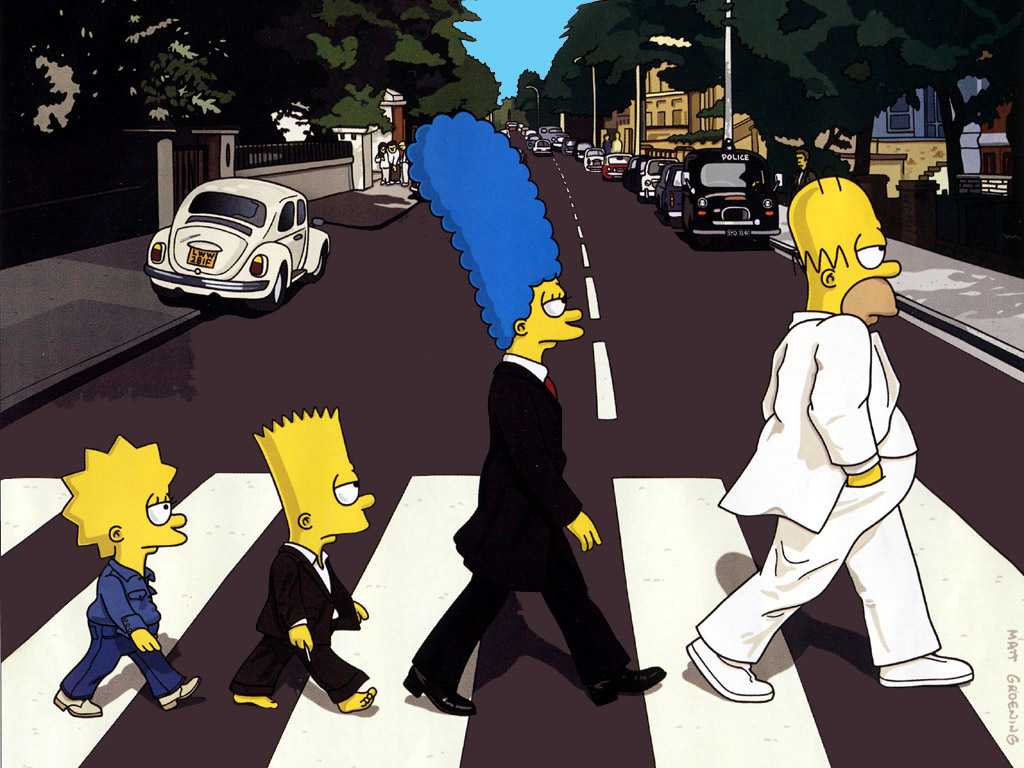
For my artifact I choose The Simpsons. Not only is this the longest running comedy on TV, and beside the fact that it’s a pop culture icon, the creators and writers have affectively incorporated most pop culture ideals into the 20 years of the series. The picture below shows some of the characters intermingled with a Beatles reference, and as we all know, the Beatles are a long standing pop culture icon. The creators of The Simpsons have found a way to continuously apply their animations to the evolving world of popular culture.
Popular culture is basically anything and everything around us that influences how we live our life, what we wear, the music we listen to, and the television shows we watch. As fads rapidly come and go people are very inclined to follow suit and resemble famous actors or sports figures, or listen to specific songs because they are hot at the moment.
Why is an understanding of popular culture relevant to you in a business environment and in your present and future career?
Understanding popular culture and why individuals do some of the things they do will help me become more sensitive to specific cultures and why they may dress or act a certain way. Being in tune with the world, whether at an employee or managerial level, will only help situations if I’m aware of what’s going on around me.
What would you consider to be an example of a pop culture artifact? And why would you choose it?
For my artifact I choose The Simpsons. Not only is this the longest running comedy on TV, and beside the fact that it’s a pop culture icon, the creators and writers have affectively incorporated most pop culture ideals into the 20 years of the series. The picture below shows some of the characters intermingled with a Beatles reference, and as we all know, the Beatles are a long standing pop culture icon. The creators of The Simpsons have found a way to continuously apply their animations to the evolving world of popular culture.
Subscribe to:
Comments (Atom)